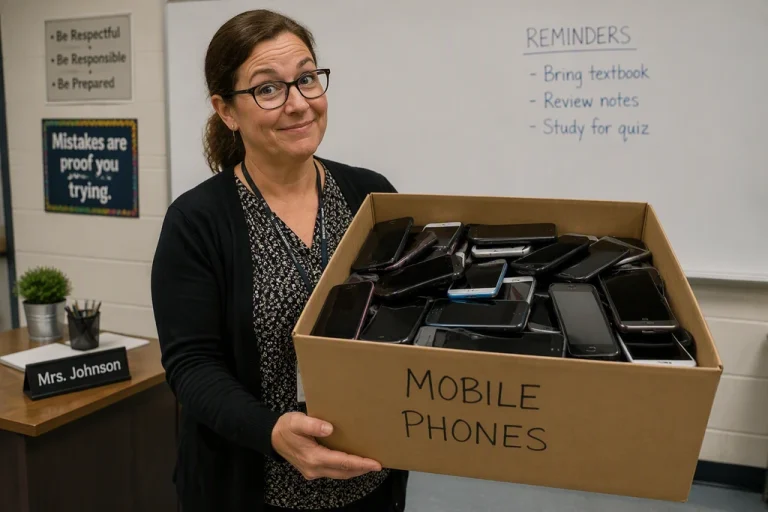



Phone-Free Schools: Answers to Parents’ Most Common Questions

A practical parents guide to school phone policies including phone bans, phone pouches, exemptions, contacting children and more.
Mobile phones are embedded in our everyday life. They are amazing pieces of tech, giving us an instant window into the total sum of human knowledge. On the other hand we all know how hard it is to ignore a phone’s constant notifications and alerts, and how disruptive they can be.
The role of phones in schools changed significantly at the start of September 2026 when new Department for Education guidance said all schools had to implement a mobile phone policy. For parents, the policy their child’s school puts in place can raise a variety of practical questions:
- Can my child take their phone to school?
- How will I contact them?
- Where will their phone be kept?
- What happens in an emergency?
This parents’ guide to phone policies explains what you need to know about phone-free schools and the practical approaches schools are using to manage children’s mobile phones.

Why Are Schools Going Phone-Free?
The main reason is to create a calmer, safer and more focused environment for learning, which makes sense when that is the main reason children go to school in the first place. Mobile phones in classrooms and break times create all manner of distractions through notifications, messaging, social media, gaming, videoing and photography. They can also contribute to online bullying, inappropriate recording and other safeguarding concerns.
One piece of research, into mobile phone use in New Zealand schools, showed teachers and pupils were in favour of regulating students’ phone use at the school, but were less happy with the idea of a total ban. Most people thought phones during class time were a distraction to learning and compromised student safety through inappropriate use, for example photos and videos being taken at school and shared, cyberbullying and social media-related problems. In line with this and similar research, the Department for Education decided all schools in England must have a policy banning mobile phone use throughout the school day, including lessons, breaks and lunchtime.

Can My Child Still Take Their Phone to School?
Yes, in many schools a child can still take a phone onto the premises. Phone bans tend to focus on how pupils use the device, not necessarily preventing pupils from bringing their phones to school in the first place.
Schools themselves can decide exactly how phones are managed, as long as their approach meets the guidance. Some schools require phones to stay switched off and out of sight, others use secure locker storage or portable, lockable phone pouches. As a parent you should check your own school’s mobile phone policy rather than assuming every school operates the same way.
What Is a Lockable Phone Pouch?
A lockable phone pouch lets every child keep their own phone with them, but they are unable to access it during the school day. They put the phone inside the pouch, which is then securely locked. At the right time, the pouch is opened using an authorised unlocking device.
For parents, one important advantage is the phone remains with the child, not collected and stored centrally. The child is given their own pouch, which they carry around with them all day.
High-quality pouches can also include signal blocking technology, which means there are no incoming calls and notifications to create distractions. The phone is not just locked away. It is silent, not receiving signals. At the end of the day, once it is unlocked, the phone can reconnect to receive the day’s notifications, messages and so on.
FoneAway lockable phone pouches, for example, are designed specifically for environments like schools and businesses where mobile phone use needs to be restricted. The system combines secure locking with signal-blocking technology and robust construction.

How Will I Contact My Child During the School Day?
Parents should normally contact the school rather than calling or messaging their child directly via mobile phone. This will be clearly explained as part of the school’s phone policy. It is a big change for some families, but it is all for a good cause. It completely removes the pressure on children to monitor messages and calls during lessons and breaks, allowing them to enjoy socialising ‘In Real Life’.
What If My Child Has a Medical or Other Special Requirement?
Schools can make ‘appropriate’ and ‘reasonable’ adjustments and exemptions if necessary. Some children need access to a mobile phone or other smart device because of a medical condition, disability or special educational need. As a parent of a child with these needs, you know best. Parents should discuss their child’s individual circumstances directly with the school rather than assuming a blanket phone restriction applies in every situation.
Are Phone-Free Schools Actually Better for Children?
The purpose of a phone-free policy is to reduce distraction, creating a calm environment where pupils can concentrate, focus, enjoy learning, socialise in person, communicate face-to-face and join in fully with school life. These things are all beneficial to children.
It is a big change for some families, but a phone ban completely removes the pressure on children to monitor messages and calls during lessons and breaks, allowing them to enjoy socialising ‘In Real Life’.
There is a large and growing body of research into mobile phones in schools. Concerns about the impact of mobile phone use on young people’s learning, behaviour and wellbeing have led many countries to bring in restrictions or bans in schools. These days researchers tend to recommend balanced, flexible policies that limit distractions, not strict universal bans.
What Should Parents Look for in a School Phone Policy?
A good school phone policy should clearly explain:
- If pupils can bring their phones onto the school premises
- Where their phones will be kept during the school day
- How the policy is going to be enforced
- What happens if a child breaks the rules
- How parents can contact their child
- What happens in an emergency
- Any exemptions for medical or special educational reasons
- What happens at the beginning and end of the school day.
FAQs
Here are some quick answers to some of the most frequently asked questions from parents.
Click here to see more FAQs relevant to mobile phones in schools.