


How Signal Blocking Phone Pouches Work

Find out how signal blocking phone pouches work, including Faraday and RFID tech, and why schools & businesses use them to cut phone distractions.
Mobile phones constantly search for networks, Wi-Fi, Bluetooth devices, GPS signals and other wireless connections, often without the user doing anything or knowing about it. It’s precisely what makes smartphones so useful and, on the other side of the coin, so distracting.
For schools, businesses and other organisations where mobile phone use needs to be restricted, a signal blocking phone pouch provides an alternative to switching a phone off, asking users to put theirs away or physically confiscating them. But how does signal blocking actually work?
- What is a Faraday phone pouch?
- Is an RFID phone pouch the same thing?
- Does a signal-blocking pouch really stop a phone receiving calls and messages?
- What happens to the phone while it’s inside?
This detailed guide explains the technology in straightforward terms, exploring what schools and businesses should consider when choosing a signal blocking phone pouch.
An important technical distinction
First, some clarity around the tech. While RFID (Radio-Frequency Identification) is a type of radio frequency technology, ‘Faraday‘ describes signal blocking. An RFID phone pouch and a Faraday phone pouch rely on similar underlying technology, but they’re not always technically interchangeable. More about that later.

What is a signal blocking phone pouch?
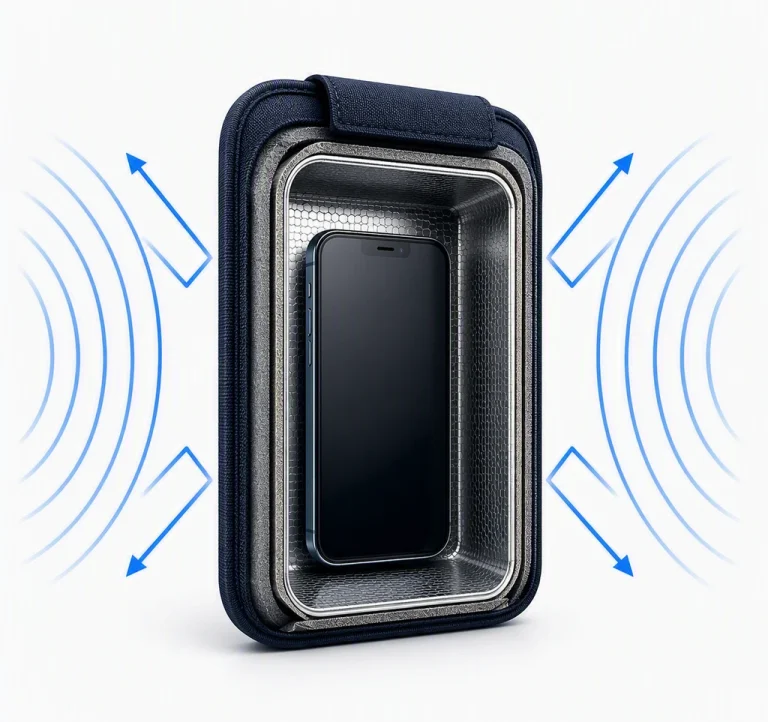
A signal blocking phone pouch is designed to reduce or prevent radio-frequency signals reaching the mobile phone inside. The principle is based on the Faraday cage, named after English scientist Michael Faraday.
A Faraday cage is an enclosure made from or including a conductive material that shields the contents from electromagnetic fields and radio-frequency signals. A phone pouch uses the same basic principle in a flexible, portable form.
When a mobile phone is completely enclosed inside the pouch, the conductive shielding material significantly ‘attenuates’ or turns down the wireless signals entering or leaving the pouch. Depending on the construction and effectiveness of the shield, this interferes with:
- Mobile phone signals
- Wi-Fi
- Bluetooth
- GPS
- Other radio-frequency communications.
The pouch doesn’t physically disable the phone. It creates a shield around it, making signal blocking particularly useful when you want people to keep their phones with them while preventing them from being used or receiving a constant stream of distracting notifications.

How does a Faraday phone pouch work?
The easiest way to understand a Faraday phone pouch is to imagine putting the phone inside a protective envelope made from conductive material. A smartphone normally communicates with the outside world by transmitting and receiving electromagnetic radio signals. For example:
- Phone → mobile mast: The phone transmits a radio signal to the cellular network
- In the opposite direction mobile mast → phone: The network sends signals back to the phone.
The same basic principle applies to Wi-Fi, Bluetooth and other wireless technologies. When the phone is inside a conductive shield, these signals hit a barrier. Instead of freely passing through the pouch, most of the electromagnetic energy is reflected away or absorbed by the shielding material, delivering a dramatic reduction in the strength of the signals reaching the phone. Assuming the shielding is good enough, the phone can’t communicate reliably with the outside world. This is the basic principle behind a Faraday phone pouch.

What is a Faraday cage?
A Faraday cage doesn’t necessarily look like a cage. The term describes the principle, not the shape. A traditional Faraday cage might be made from a conductive metal mesh or enclosure. A phone pouch achieves a similar effect using conductive materials incorporated into flexible layers within the pouch. How effective the shield is depends on:
- The materials
- Their conductivity
- The frequency and strength of the signals being blocked
- The construction of the pouch
- The quality of its seams and closures
- Whether the phone is completely enclosed.
This is why simply putting a phone into an ordinary fabric pouch doesn’t make it a Faraday pouch. A normal phone case or fabric bag safely hides the phone, protecting it from scratches and making it harder to access, but it doesn’t provide the RF shielding required.
Is an RFID phone pouch the same as a Faraday phone pouch?
The terminology can be confusing. RFID stands for Radio Frequency Identification. It uses radio waves to communicate information between a reader and a compatible RFID tag or device. An RFID phone pouch contains material that interferes with radio-frequency communication. A Faraday phone pouch refers to the broader shielding principle used to block or mute (attenuate) electromagnetic radio signals.
Manufacturers use different names, including:
- RFID phone pouch
- RFID blocking phone pouch
- Faraday phone pouch
- Faraday cage phone pouch
- Signal blocking phone pouch
- Signal blocking mobile phone pouch.
These terms can overlap, but they don’t automatically prove that two products perform exactly the same. For schools and businesses, the most useful question is not: Does it say RFID? The important question is: Which signals does the pouch block, and how well?

What signals can a signal blocking phone pouch prevent?
Modern smartphones use various wireless technologies. A well-designed signal blocking pouch interferes with radio-frequency communications between the device and the outside world, including these.
Mobile networks
A smartphone normally communicates with its mobile network to make and receive calls, send and receive messages and use mobile data. Effective signal shielding prevents or substantially reduces the communication.
Wi-Fi
Phones regularly search for and connect to wireless networks. A signal-blocking pouch stops the phone communicating with Wi-Fi networks while inside.
Bluetooth
Bluetooth is used to communicate with nearby devices like headphones, speakers, smartwatches and other accessories. RF shielding interferes with Bluetooth communication.
GPS
GPS works differently from mobile phone communication. Phones get weaker signals from satellites rather than communicating directly with a mobile network. But GPS radio signals can also be turned down or ‘attenuated’ by appropriate RF shielding.
Does a signal blocking pouch switch the phone off?
No, and it’s an important distinction. A signal blocking phone pouch does not switch the smartphone off, nor does it physically disable the electronics. Instead it prevents or dramatically reduces the radio signals the phone can receive and transmit. The phone itself stays on, so any functions not requiring an external wireless signal can still operate. For example, depending on the device, a phone might still be able to:
- Display the time
- Run an offline alarm
- Access information stored locally on the phone
- Use its camera
- Play downloaded media
- Carry out other tasks that don’t need a wireless connection.
But since the phone is locked inside the pouch these capabilities would not be accessible.
Importantly for schools, the student’s phone remains their property and stays physically with them, but the device is no longer continually communicating with the outside world and they can’t access the phone to use any of its functions.
Why does signal blocking matter in schools?
The educational case for controlling mobile phone access is not just about preventing students from looking at their screens. A smartphone can still be a source of distraction even when nobody is using it.
Notifications, vibrations, incoming calls, messages and other alerts can interrupt pupils’ concentration. They might know a message has arrived without being able to see its contents, creating another type of distraction: the temptation to check the phone, a kind of FOMO or ‘Fear Of Missing Out’. A signal blocking pouch addresses the problem by removing the incoming wireless connection while the device is inside.
Recent UK government guidance says schools must have a policy prohibiting mobile phone use throughout the school day, including lessons, between lessons, breaktimes and lunchtime. The statutory guidance came in on 29th June 2026 and schools started following it from 1st September 2026.
The technology is best classified as a possible practical enforcement mechanism, rather than the policy itself. Because the pouches can’t create a successful phone-free school on their own, schools still need to set up clear rules, communication and consistent implementation, and decide on any exceptions to the rule.
What happens to calls and messages?
Under normal circumstances, a smartphone constantly communicates with networks. When enclosed in a good quality signal-blocking pouch, the phone loses its wireless connection. Incoming calls, messages and other network dependent notifications can’t be delivered normally while the shield is in place and working properly.
This is particularly relevant in schools. A phone that continues to get notifications is still a powerful psychological distraction even when the pupil has been asked not to use it. A signal blocking phone pouch removes the connection altogether.
It is worth remembering signal blocking is not always perfect all of the time. Different phones work across different frequencies and network technologies, and the signal strength varies dramatically between locations.
The quality and build of the pouches also matters. Schools need trustworthy information about the shielding technology and, ideally, should test samples before committing to a large order of a particular pouch.
What makes an effective signal blocking pouch?
Not all pouches are the same. When you’re buying hundreds or thousands of units, relatively small differences in the construction can become significant over years of daily use.
1. The shielding material
The pouch needs an effective conductive shielding layer. Just because a pouch is described as ‘RFID blocking’, it doesn’t mean you know everything you need to know about its real life performance.
2. Complete enclosure
The shielding needs to surround the device completely because any gaps, openings and poorly designed closures mean the effect isn’t as good as you need it to be.
3. Construction quality
Pupils attend school for around 190 days a year. Schools can easily use the same pouch hundreds of times during one academic year. So examine the stitching, seams, closures, reinforcement and the materials used throughout the pouch to make sure you make a wise buying decision.
4. Locking mechanism
When your goal is to restrict access rather than just encourage students not to use their phones, the pouch must have a rugged, secure and practical locking mechanism.
5. Device capacity
Modern phones vary widely in size. Check the pouch will comfortably fit all the devices students use, rather than assuming every phone will fit inside.
6. Ease of unlocking
The system needs to work at scale. When 500 or even 2000 pupils all need to unlock their pouches at the end of the school day, an awkward unlocking process can quickly become an operational headache.
7. Durability
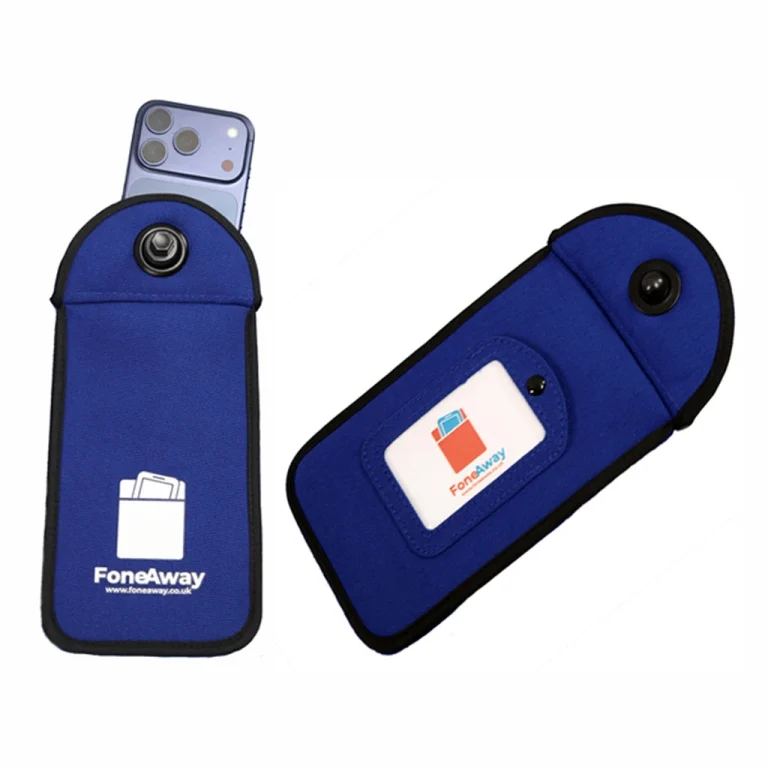
Remember this is an everyday piece of equipment, not something that’ll sit unused in a cupboard. Schools should make sure the pouch is tough enough for repeated daily handling. FoneAway, for example, has a tough canvas outer body with plenty of internal neoprene padding, an integrated signal-blocking lining, a concealed locking mechanism plus dedicated magnetic unlocking devices.
Can businesses use signal blocking phone pouches?
Absolutely. The tech isn’t only for the education sector. Businesses might want to restrict mobile phone access in particular areas or during particular activities, for example:
- Confidential meetings
- Research and development environments
- Financial trading and legal settings
- Executive briefings
- Film and media production
- Sensitive commercial facilities.
The objective could be to reduce distractions, maintain confidentiality, protect intellectual property or prevent unauthorised photography and recording. Whatever the intent, FoneAway is designed for these environments as well as schools. Businesses can deploy the system company-wide, focus on specific areas, or use the tech for particular groups of employees and visitors.
Does a Faraday pouch protect privacy?
Signal blocking pouches contribute to privacy protection because they stop or interfere with wireless communication while a device is inside. On the other hand a pouch isn’t a complete cybersecurity or privacy solution. It doesn’t replace:
- Cybersecurity control
- Device management
- Access control
- Data protection
- Physical security
- Employee training
- Information security procedures.
Instead, think of it as a physical layer of control. Maybe, for example, your business is holding a highly confidential meeting. You might use signal-blocking pouches alongside existing information security procedures to reduce the risk of mobile devices communicating or being used during the meeting.
Are signal blocking pouches safe for mobile phones?
A properly designed signal-blocking pouch won’t damage the phone inside when it blocks wireless communication. But there is one practical consideration.
When a phone repeatedly tries to make a network connection in a place where the signal isn’t available it might try to send and receive data, but without a signal it can’t make a connection. This can lead to dropped calls, slow data speeds, and service interruptions. The phone might also display a message saying it can’t connect to the network. In some cases the phone might try to connect to a different network and if it fails, become unresponsive. These issues are easy to resolve by restarting the phone or checking for network settings once the phone is outside its pouch.
The pouch itself should also protect the phone from normal knocks and handling. For schools this is almost as important as signal blocking. FoneAway’s construction combines a signal-blocking lining with internal neoprene padding to protect devices during everyday use.
The bottom line: How does a signal blocking phone pouch work?
- A signal blocking phone pouch works by surrounding a mobile phone with conductive shielding to attenuate or turn down radio-frequency signals. The principle is based on the Faraday cage
- When the phone is properly enclosed, the shielding interferes with cellular, Wi-Fi, Bluetooth, GPS and other wireless communications, depending on the pouch’s build and the frequencies involved
- The terms RFID phone pouch, Faraday phone pouch and signal blocking phone pouch all describe products with closely-related shielding technology. Buyers should always check precisely what a particular product is designed to block
- For schools and businesses, the biggest benefit is phones don’t have to be confiscated. The owner keeps their device on them but access and wireless communications are restricted
- For schools looking to create a calmer, more focused learning environment, this can provide a straightforward physical mechanism to support their wider mobile phone policy
- When choosing a signal blocking phone pouch consider the technology, construction, durability, locking system, ease of deployment and the practical needs of the people who will use it every day.
Creating a More Focused Environment
Mobile phones are not going away. The challenge for schools and businesses is deciding when constant connectivity is useful and when it becomes a problem. Signal blocking technology offers one practical way to draw this vital boundary. By combining effective RF shielding with secure, easy-to-use pouches organisations can restrict mobile phone access without having to confiscate devices. For schools in particular, this forms part of a wider strategy designed to create a calmer, safer and more distraction-free environment for learning and socialising.
FoneAway provides signal blocking phone pouch solutions for schools, businesses and other organisations. To find out more about the technology, implementation options and how a pouch system could work in your organisation, visit FoneAway-phone-pouch.co.uk.
FAQs
Here are some quick answers to some of the most frequently asked questions about signal-blocking phone pouches.