


What Should a School Mobile Phone Policy Include? (Free Checklist)

What should a school mobile phone policy include? Use our practical checklist to set up a clear, consistent, effective phone-free school policy.
A good school mobile phone policy should do more than simply say pupils can’t use their phones. It should explain exactly what is not allowed, when the restrictions apply, and what happens if a pupil breaches the policy. It’s also important to formalise the way any exceptions are managed and pin down how the school will communicate the rules to pupils, parents and staff.
The Department for Education’s revised mobile phones in schools guidance expects schools to create a mobile-phone-free environment by default, where pupils don’t access their mobile phones during the whole school day including lessons, between lessons, at breaks and lunchtime. But a successful policy is not simply about compliance. It needs to work in real life.
Teachers must find it easy to enforce consistently. Pupils need to understand exactly what’s expected of them. Parents should know how to contact their children. And schools need sensible arrangements for pupils who have legitimate medical, SEND, safeguarding or other needs.
This detailed guide reveals what a school mobile phone policy should include, together with a practical mobile phone policy checklist school leaders can use when creating or reviewing their policy.
What should a school mobile phone policy include?
A comprehensive school mobile phone policy should cover all this:
- The policy’s purpose
- Who it affects
- Which devices are covered
- When the restrictions apply
- When mobiles will be taken
- Where they’ll be stored
- Whether or not phones can be brought onto school premises
- The enforcement method
- Consequences of breaking the rules
- Any confiscation arrangements
- Exceptions and reasonable adjustments
- Medical and SEND requirements
- The rules for sixth-form pupils
- Expectations for school staff
- Responsibilities for parents and carers
- Emergency communication
- Searching and safeguarding procedures
- Arrangements for activities outside normal school hours
- The way the policy will be communicated
- How and when the policy will be reviewed
As you can imagine, the most effective policies are specific, not vague. It’s no good saying ‘mobile phones must not be used in school’, because it leaves too much room for misunderstandings. A well-written policy answers all the possible questions before they become problems.

Why does a school need a mobile phone policy?
Mobile phones have useful communication and safety benefits, but unrestricted access during the school day creates challenges. Pupils are distracted by notifications, messaging, social media, gaming, photography, video recording and more, which compete for attention when they should be learning. Phones also create behaviour and safeguarding issues.
The DfE’s current guidance says schools should be mobile-phone-free by default, but lets schools figure out the best way to apply the rules to suit their circumstances, either:
- Phones switched off and stored in bags
- Phones put in lockers
- Phones handed to staff
- Phones collected at the school entrance
- Lockable mobile phone pouches
- A combination of these approaches depending on the year group.
The right choice depends on the buildings, pupil population, staffing, existing behaviour systems and safeguarding arrangements at your school.
What is the difference between a school phone policy and a school behaviour policy?
A mobile phone policy can either be a stand-alone document or part of a wider behaviour policy. The DfE specifically says either approach is acceptable but both policies must work together. The mobile phone policy should explain the specific rules surrounding phones and similar devices. The behaviour policy establishes the wider framework for expectations, sanctions and managing behaviour. Basically you’re looking at a clear connection from expectation to rule to consequence.
- Behaviour policy: Pupils are expected to follow reasonable instructions from staff and comply with school rules
- Mobile phone policy: Pupils must not access or use their mobile during the school day, except when there’s an agreed exception
- Enforcement: Breaches will be subject to the school’s sanctions.

1. Start with the purpose of the policy
The best policies explain why the school is restricting mobile phone use. It’s more important than you might think. When pupils and parents see the policy as a prohibition, it can become a battle over personal freedom. When you explain the purpose clearly, the policy becomes part of an overall plan to create a calm, safe and focused learning environment.
Here are some of the objectives you’ll want to cover:
- Reducing classroom distraction
- Supporting learning and concentration
- Cutting back disruption between lessons
- Supporting positive behaviour
- Encouraging face-to-face socialising
- Cutting down the opportunity for cyberbullying during the school day
- Reducing unauthorised photography and recording
- Supporting safeguarding
- Protecting pupils from unnecessary online distractions
- Creating consistent expectations across the whole school.
The purpose of the policy is to ‘create a calm, focused and safe school environment by preventing unnecessary access to mobile phones and similar smart devices during the school day’. You can use and adapt this wording to match your school’s values and behaviour strategy.
2. Clearly define which devices are covered
As well as smartphones, pupils might have:
- Basic mobile phones
- Smartwatches
- Other devices capable of sending messages
- Other devices capable of recording audio or video
- Other connected communication devices.
The DfE says schools need to mention other communication and smart tech with similar functions. You’ll need to clearly define exactly what you mean by a mobile phone or smart device to avoid arguments.
3. State exactly when the policy applies
Grey areas are never helpful. Instead of saying ‘phones are not allowed during school hours‘ you should be specific about the period covered. As well as clarifying what ‘throughout the school day’ means, it is helpful to also explain what happens:
- Before registration
- At the end of the school day
- During after-school clubs
- During detention
- During school trips and residential trips
- At sporting events and school performances
- During exams.
4. Explain whether pupils can bring phones onto school premises
Your school’s mobile phone policy should distinguish between bringing a phone to school and having access to it during the school day. The DfE allows schools to create their own approach. Government case studies suggest different models, including phones being stored rather than prohibited altogether. You might express it like this:
‘Pupils may bring a mobile phone onto the school premises where required for their journey to and from school, but the device must not be accessed during the school day and must be stored in accordance with this policy’.
You might decide phones shouldn’t be brought onto the premises at all. Whatever your school decides, the policy should be unambiguous.
5. Explain exactly how phones will be stored
Your school can have an excellent policy on paper but still struggle without reliable enforcement.
Phones stored in school bags – Simple and low cost but depends on pupils complying.
Phones stored in lockers – Consider locker capacity, accessibility and whether pupils can easily get their phones out during the school day.
Phones collected by staff – This can create a heavy admin burden thanks to:
- Collection arrangements
- Labelling
- Secure storage
- Responsibility for devices
- Lost or damaged phones
- Returning the right gadget to the right child
- Staff time
- Safeguarding
- End-of-day collection
- Queues.
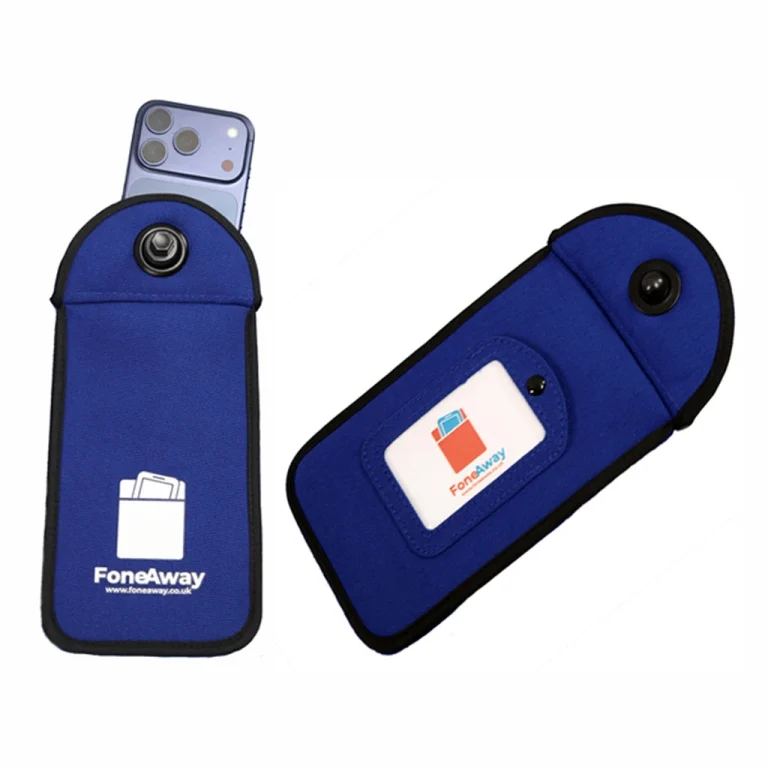
Lockable phone pouches – Many schools are considering individual lockable pouches as an alternative to central collection. A pupil puts their phone into a personally allocated pouch, which is locked and remains with them until the authorised time. Staff don’t need to handle hundreds of devices at the start and end of the day. You can read a case study about a secondary school using phone pouches here.
6. Include a clear enforcement procedure
Your enforcement policy needs to answer one practical question: What happens when a pupil breaks the rule? The procedure should be easy for staff to understand and apply consistently. For example:
- The pupil is reminded about the policy
- The phone is dealt with according to school procedure
- The incident is recorded if appropriate
- The right sanction is applied
- Repeated breaches are escalated in line with the behaviour policy
- Parents or carers are contacted if necessary.
The DfE says staff should consistently enforce the policy, and schools should make sure staff, pupils and parents understand it and the sanctions.
7. Be specific about confiscation
If confiscation is part of your approach, the policy should clearly explain:
- When confiscation will happen
- Who is authorised to confiscate
- Where the devices are stored
- How the devices are recorded
- How long they can be kept by the school
- Who can collect them
- What happens if a pupil refuses to hand over their device
- How repeated breaches are handled
- How safeguarding is managed.
The DfE guidance says confiscation can be effective as a deterrent, but schools need to think carefully about the outcome of disciplinary action, explore alternative approaches, and consider each pupil’s circumstances including age and SEND. This is one good reason why schools choose a system that prevents access without expecting staff to physically take pupils’ phones off them.
8. Include medical and SEND exceptions
It’s no good making a blanket statement like ‘no pupil may use a mobile phone under any circumstances’ because schools have other legal duties. The DfE guidance says pupils might need mobile phone access because of disability, medical conditions or other circumstances. For example pupils with diabetes might need to use a mobile phone-linked glucose monitor. You also need to meet your obligations under the Equality Act 2010. Your policy should explain:
- How exceptions are requested
- Who approves them
- What evidence is needed
- Where the phone can and can’t be used
- Whether the phone has to stay under staff supervision
- How the arrangement is recorded
- When the arrangement is reviewed.
It’s important to be clear that exceptions don’t always mean unrestricted access. The DfE recommends allowing a pupil to use their phone for a specific purpose at specific times and locations.
9. Consider safeguarding and vulnerable pupils
You will need to decide whether individual circumstances create a legitimate safeguarding reason for flexibility. Your policy should provide a mechanism for decisions rather than an exhaustive list of every possible exception. This could include:
- Safeguarding concerns
- Young carers
- Medical requirements
- SEND
- Assistive technology
- Individual welfare needs.
The government’s 2026 consultation response identified medical needs, SEND, safeguarding and caring responsibilities as relevant circumstances. The key principle is exceptions should be controlled, documented and purposeful, and the general rule should never become optional.
10. Decide how sixth-form pupils will be treated
Sixth forms come with different circumstances. Because mature pupils have more independence and responsibility, you might decide limited access is appropriate in certain circumstances. The DfE guidance says schools should think about giving access at limited times and places as long as it doesn’t undermine the wider policy. You might consider allowing phones:
- In a designated sixth-form common room
- During defined study periods
- In specified areas
- Outside the teaching day.
Whatever your chosen approach, it should be written down.
11. Include expectations for staff
A successful phone policy requires staff to lead the way, for consistency. The DfE guidance says staff shouldn’t use their own mobile phones for personal reasons in front of pupils during the school day, although there can be legitimate professional reasons for it. So your policy should explain:
- When staff can use their mobile phones
- Where personal phones should be kept
- What ‘legitimate professional use’ actually means
- How emergencies are handled
- How staff model the school’s expectations.
12. Explain how parents can contact their children
This is one of the first questions parents tend to ask, and your policy should answer directly. It might say:
‘Parents and carers should contact the school reception in the first instance rather than contacting pupils directly via their mobile phone during the school day’.
You need to provide the school’s main contact number, explain how urgent messages are passed to pupils, how you will handle emergencies and how parents should contact the school about safeguarding concerns. The DfE provides specific guidance on communicating mobile phone policies to parents.
13. Explain what happens during trips and residential visits
What happens on day and residential trips, sport fixtures, school camps and overseas trips? The DfE says schools must pin down how mobile phones are managed in these circumstances, while making sure the educational experience isn’t disrupted. It might make sense to create a separate trip-specific risk assessment or procedure.
14. Include searching and safeguarding procedures
If the school intends to search pupils for mobiles, you must reflect it in the behaviour policy and procedures. The DfE states headteachers and authorised staff have statutory search powers in specific circumstances, which means staff must understand:
- When a search is allowed
- Who can conduct it
- What procedures to follow
- What happens if a phone is found
- When safeguarding procedures come into play.
15. Say what happens to phones at the end of the day
It might seem obvious, but you have to be explicit. If phones are stored in lockers, say:
‘Pupils may retrieve their phones at the end of the school day’. If phones are held centrally, say: ‘Phones will be returned in accordance with the school’s collection procedure’.
If you use phone pouches say:
‘Pupils may unlock their allocated pouches at the authorised release point at the end of the school day’.
Clear procedures reduce congestion, prevent arguments and stop confusion.
16. Explain responsibility for loss or damage
If the school provides a storage system, your policy should explain:
- Whether pupils remain responsible for their phones
- Whether the school accepts liability for damage or loss
- What happens to damaged devices
- Who is responsible for replacement pouches or storage equipment
- How lost property is dealt with.
It’s important to take legal and insurance advice instead of just relying on a generic statement.
17. Communicate the policy before implementation
Even an excellent policy can fail if pupils and parents only find out about it on the first morning of the new term. The DfE recommends communicating the policy clearly to pupils, parents and staff in advance to head off any issues before the new system is put in place.
The School Mobile Phone Policy Checklist
Use this mobile phone policy checklist when reviewing an existing policy or preparing a new one.
Policy and purpose
- The purpose of the policy is clearly explained
- It aligns with the school’s behaviour policy
- It identifies exactly who it applies to
- It defines the school day
- It has a named owner
- It includes a review date.
Devices
- Mobile phones are clearly defined
- Smartwatches, similar devices, other communication and recording devices are all considered
- The policy explains whether phones can be brought onto the school premises.
Restrictions
- The policy states exactly when phones cannot be accessed
- During lessons
- Between lessons
- Breaktimes
- Lunchtimes
- Arrangements before and after school
- Trips and residential visits.
Storage
- The school’s storage method is explained
- Pupils know where phones must be stored
- Staff responsibilities are clear
- End-of-day arrangements are clear
- Lost or damaged devices are addressed.
Enforcement
- The policy explains what happens after a breach
- Any sanctions are clear
- Confiscation arrangements are documented
- Repeated breaches are addressed
- Staff know how to enforce the policy consistently.
Exceptions and inclusion
- Medical needs are addressed
- SEND requirements are considered
- Reasonable adjustments are considered
- Safeguarding circumstances can be considered
- Individual exceptions have an approval process
- Exceptions specify exactly when and where phone access is allowed
- Sixth-form arrangements are addressed separately.
Staff and parents
- Staff expectations are included
- Parent and carer responsibilities are explained
- Parents know how to contact the school
- Emergency communication arrangements are clear
- You mention the places the policy is published
- Pupils and parents receive information before implementation.
Safeguarding
- Searching procedures are linked to the school behaviour policy
- Staff know when safeguarding procedures apply
- Online safety considerations are included
- The policy works alongside the school’s wider safeguarding arrangements.
What makes a school mobile phone policy effective?
A policy does not work well just because it contains all the right words. It needs to work operationally in the real world. Five characteristics define the best policies:
- Clear: Pupils, parents and staff should understand the rules without having to interpret them.
- Consistent: The same basic expectations apply across classrooms, corridors, breaktimes and lunchtime.
- Practical: The system doesn’t require staff to spend hours every morning collecting, labelling and storing hundreds of phones.
- Proportionate: The policy recognises legitimate individual needs and takes appropriate exceptions into account.
- Enforceable: You have a realistic way of turning the written policy into everyday practice.
What should a school phone policy template look like?
A school phone policy template should be detailed enough to deliver clarity, but flexible enough for a school to adapt it to its own circumstances. Here’s a sensible structure to base yours on:
- Policy statement
- Purpose
- Scope
- Definitions
- Legal and regulatory context
- Rules for mobile phones
- Devices covered
- School day restrictions
- Storage arrangements
- Enforcement
- Sanctions
- Arrangements for confiscation
- Medical, SEND and safeguarding exceptions
- Sixth-form arrangements
- Staff, parent and carer responsibilities
- Emergency communication
- Trips and residential visits
- Searching procedures
- Data protection and online safety considerations
- Monitoring and reviewing
- Implementation date
- Review date.
Final thoughts: Build the mobile phone policy around the school
If staff can’t implement and enforce the policy, it has failed. The way a school achieves the goal is all about the implementation. Some schools choose lockers. Others collect phones. Some prohibit phones entirely and others invest in individual lockable pouches.
The important thing is to choose an approach that fits the school’s environment and lets staff enforce the policy consistently. If you’re exploring physical access control, FoneAway provides lockable mobile phone pouches designed to create a genuinely distraction-free school environment without making staff responsible for hundreds or thousands of expensive gadgets. A pouch approach means pupils can learn, communicate and socialise without their attention constantly being pulled towards a screen. A clear policy is how it all starts.
More guidance for schools
For the latest official information, consult the Department for Education’s:
- Mobile phones in schools guidance
- Guidance on communicating the policy to parents
- Mobile-phone-free school case studies
- Children’s Wellbeing and Schools Act 2026 explanatory notes.
FoneAway also provides practical information about implementing lockable phone pouch systems in schools, written for leaders looking for an effective way to turn a written policy into a workable, everyday system.
FAQs
Here are some quick answers to some of the most frequently asked questions about school mobile phone policies.
Click here to see more FAQs relevant to mobile phones in schools.