


Michael Faraday and the Science Behind Signal Blocking Phone Pouches

Discover how Michael Faraday’s work on electromagnetic fields led to Faraday cages and the technology behind signal blocking phone pouches.
Michael Faraday was one of the most important figures in the development of modern electrical technology. His experiments with electricity, magnetism and electromagnetic fields led to discoveries that still influence the tech we use today, including the principle behind signal blocking phone pouches.

You might not naturally connect an 1800s British scientist with a modern mobile phone pouch, but the connection is surprisingly direct. The technology used to stop a mobile phone communicating with the outside world is based on a scientific principle called a Faraday cage. Faraday demonstrated the principle nearly 200 years ago, showing how enclosing something inside a conductive enclosure can shield it from outside electrical influences. The same basic idea is being applied on a small scale today in the design of special pouches to block mobile phone signals.
For schools and businesses wanting to create phone-free environments, understanding the science behind the tech helps explain why a well designed signal blocking pouch works and why the construction quality matters.
Who was Michael Faraday?
Michael Faraday was born in London in 1791. He didn’t take the conventional route into science, first apprenticed to a bookbinder as a teenager, a role giving him access to books and scientific ideas that inspired and developed his interest in experimentation. In 1813 he became a laboratory assistant at the Royal Institution, where he worked alongside leading scientist Sir Humphry Davy. Faraday went on to make all sorts of major discoveries in chemistry and physics, including in the fields of:
- Electricity
- Magnetism
- Electromagnetic induction
- Electrochemistry
- Electromagnetic fields
- The relationship between electricity and magnetism.
He also discovered benzene, investigated how gases liquefy, and explored important ideas about the way electromagnetic forces work. In fact his work was so influential that the unit of capacitance, the farad, was named after him. Most importantly of all, when thinking about signal blocking technology, Faraday helped establish the idea that electrical and magnetic effects could be understood in terms of ‘fields’.

What did Michael Faraday discover about electricity and magnetism?
One of Faraday’s most important discoveries was electromagnetic induction. Put simply, he found that changing magnetic fields generates an electrical current, leading to the 1831 experiments forming the foundation for tech like electrical generators and transformers.
Faraday was also fascinated by ‘lines of force’, a way to visualise the strange invisible influence surrounding magnets and electrical charges. And this helped pin down the modern concept of an electromagnetic field.
An electromagnetic field is simply an area around an electrically charged or magnetic object where electrical or magnetic forces have an effect. It might sound complex but electromagnetic fields are part of everyday life, involved in everything from electrical wiring and radio comms to Wi-Fi and mobile phones. And that brings us to Faraday’s connection with phone pouches two centuries later.
What is a Faraday cage?
A Faraday cage is an enclosure made from a conductive material that reduces or stops electromagnetic fields from getting inside. Faraday demonstrated the principle experimentally in 1836, creating and testing what became known as the Faraday cage while researching electricity.
In principle the science is reasonably simple. Imagine putting an object into a box made from conductive material. When an electrical field reaches the box from outside the electrical charges inside the conductive material redistribute themselves. This creates the opposite effect, reducing the electrical field inside, and the result is a protected space.
A simple way to imagine it
Basically, a Faraday cage is a barrier between the inside and outside. Electromagnetic energy encounters the conductive outer layer rather than passing straight through to whatever is inside. The exact way this happens depends on:
- The material used
- Its thickness and conductivity
- The electromagnetic radiation’s frequency
- The design of the container
- If there are any gaps or openings
- How well the container is closed – particularly important when applying Faraday’s principle to a phone pouch.

How does a Faraday cage block mobile phone signals?
A mobile phone communicates wirelessly using radio-frequency electromagnetic waves. When a phone connects to a mobile network, it sends and receives radio signals. It can also communicate using tech like Wi-Fi, Bluetooth and other wireless systems.
A signal blocking pouch uses a conductive shielding layer to interfere with these communications. When the phone is completely enclosed by a well-designed conductive barrier, the barrier dramatically reduces the strength of radio-frequency signals reaching the phone. When the signal is reduced enough, the phone can’t communicate reliably with the network or any other wireless device.
Put simply, a signal blocking phone pouch creates a shield around the phone to stop wireless signals from getting through: the fundamental principle behind a Faraday pouch.
What is electromagnetic shielding?
A Faraday cage provides a type of electromagnetic shielding, using a material or container to reduce the amount of electromagnetic energy moving between the inside and outside. This is important when engineers want to stop unwanted electrical interference from affecting sensitive equipment. The same principle can be adapted for bags, cases and pouches designed to isolate electronic devices from wireless signals.
Does a phone pouch actually block the signal?
A well-designed signal blocking pouch stops a mobile phone from communicating with external wireless networks while the phone is fully inside. But it’s important to understand exactly what ‘blocking the signal’ actually means.
The pouch doesn’t switch the phone off. Because it stays switched on inside, the screen, battery and internal electronics still work. The pouch creates an environment where the phone can’t establish or hold onto wireless connections, making it particularly useful for schools and businesses. A phone inside a signal blocking pouch remains available for authorised use when the pouch is opened, but is isolated from wireless communication while inside.
Why does the pouch need to be properly closed?
This is one of the most important practical aspects of signal blocking tech. Basically, a Faraday enclosure only works properly when the conductive shielding forms a complete barrier. Even a tiny gap lets electromagnetic energy in and out, which is why the design of a phone pouch is so much more complex than simply putting a phone inside a piece of metallic material. The shielding material has to work as part of an overall enclosure: the closure itself, the seams, construction and positioning of the phone all matter.
This is why schools and businesses need to pay attention to the quality and design of a signal blocking pouch. You can’t assume every product described as a Faraday pouch will work in exactly the same way.

What signals can a signal blocking phone pouch block?
Modern mobile phones use various types of wireless communication. Depending on the build and shielding quality, a signal blocking pouch can reduce or block:
- Mobile network signals
- Wi-Fi
- Bluetooth
- GPS-related signals.
The precise ‘level of attenuation’ – the reduction in signal strength where you make the signal weaker – depends on the construction and performance of the particular pouch and the frequency or frequencies involved. The point is, a well designed pouch cuts the strength of wireless signals enough to stop normal communication when the phone is fully enclosed inside.
Why the quality of the shielding material matters
Not all conductive materials behave in exactly the same way. This means a signal blocking pouch should be designed around the frequencies it is intended to shield as well as taking the practical side of everyday use into consideration.
The shielding material needs to be built into a pouch tough enough to survive repeated handling. This is especially important for schools where a pouch will be opened and closed hundreds of times through a series of school years.

FoneAway: Applying Faraday’s science to modern phone management
FoneAway focuses on providing a high-quality phone pouch solution for organisations wanting to create more focused, controlled and distraction-free environments.
The FoneAway-phone-pouch.co.uk approach starts with truly appreciating the problem schools and businesses are trying to solve. This means first understanding the science behind signal blocking, then choosing appropriate shielding materials and building them into a pouch rugged enough for repeated use.
Thanks to FoneAway’s attention to detail and insistence on quality, schools and businesses can make informed decisions about phone management rather than treating signal blocking as a complex process.
How FoneAway Applies Faraday’s Science
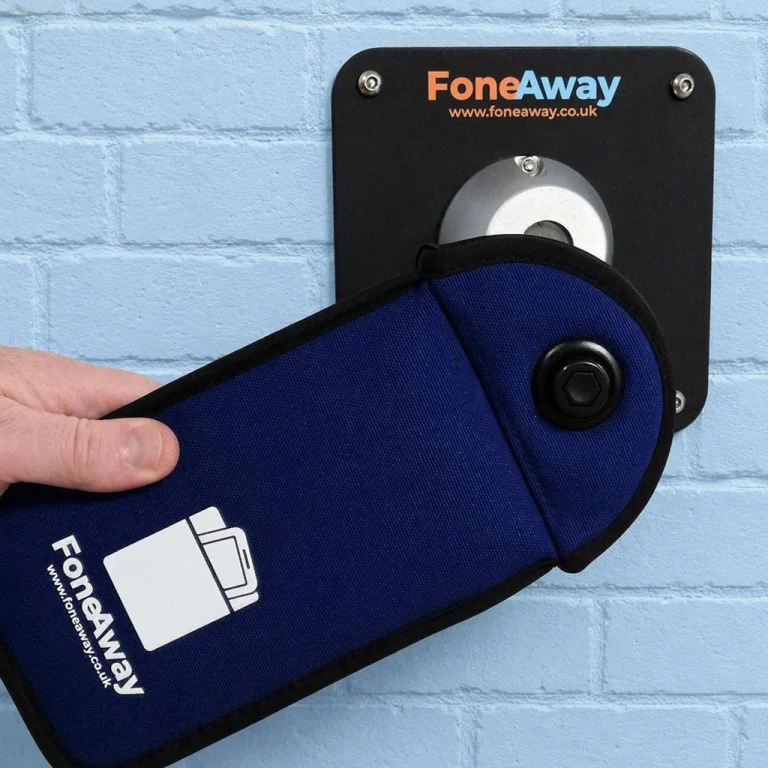
A built-in Faraday cage-style signal blocking lining is key to the FoneAway model. A conductive lining surrounding the enclosed device actually tackles the wireless connection itself via full signal blocking inside the pouch.
FoneAway combines this reliable internal signal-blocking layer with a robust canvas outer surface and strong bonded neoprene padding. The padding helps protect the phone and other contents from the knocks and everyday handling that a school or workplace pouch is likely to experience.
The pouch is designed to fit large modern smartphones, with extra capacity for tech like a smartwatch. This matters because a signal-blocking system is only effective when all the relevant restricted devices will fit inside.
The locking mechanism is also part of the solution. A strong physical lock stops users from taking the phone out. There’s a magnetic locking system with a concealed locking pin. The phone is placed inside the pouch then the locking button is pressed to secure it, and the phone can’t be removed without an authorised magnetic unlocking device.
The concealed pin itself is an important design feature. An exposed metal pin potentially creates a safety issue and can be damaged. FoneAway’s design hides the locking component inside the mechanism. Last but not least, the FoneAway pouch comes with handy customisation features for easy identification.
Faraday’s legacy lives on
Michael Faraday died in 1867, but the modern world still feels his influence via the tech we take for granted. His findings helped establish our understanding of electricity, magnetism and electromagnetic fields. His experiments with electromagnetic shielding gave birth to the principle we now call the Faraday cage, and electromagnetic shielding remains vital to modern engineering.
FAQs – About Faraday Cages and Signal Blocking Phone Pouches
Here are some quick answers to some of the most frequently asked questions about Faraday cages and signal blocking phone pouches.
Click here to see more FAQs relevant to mobile phones in schools.