


15 Benefits of a Phone-Free School Environment (Backed by Research)

Discover 15 evidence based benefits of phone-free schools, from better focus and behaviour to safeguarding, social interaction and learning.
Mobile phones have become a universal part of modern childhood. They provide a sense of security for parents, give young people instant access to friends and information, and can be useful educational tools when used appropriately. But there’s an important distinction between having a phone and having unrestricted access to it during the school day, and this sits at the heart of the growing movement towards phone free schools.
Research into school smartphone policies is developing rapidly. So far the evidence is nuanced. While there are clear reasons for reducing unnecessary phone access during the school day, particularly around distractions, behaviour and the social environment, there isn’t any reliable evidence that simply banning phones automatically improves every aspect of children’s mental health or academic performance. What we do know is that removing the opportunity to constantly check, message, scroll, make video and respond to notifications can change the learning and interaction environment for the better.
Now England’s Department for Education has set up statutory mobile phone guidance. It says schools should be mobile phone-free environments by default, with few or no exceptions unless they are deemed appropriate. Schools are expected to prohibit mobile phone use throughout the school day, including lessons, between lessons, breaktimes and lunchtime.
We have created this informational article to give parents and schools accurate insight into commonly repeated claims about phone bans, based on actual research. The article distinguishes between well-supported benefits, plausible benefits, and areas where the evidence is still mixed.
What are the benefits of banning phones in schools? Here are 15 of the most important benefits along with what the research actually tells us.
1. Fewer distractions during lessons
Perhaps the most obvious benefit of a phone-free school environment is also one of the most important: fewer distractions. Because smartphones are designed to attract attention, they naturally compete with what’s happening in the classroom. But it is about more than pupils deliberately ignoring teachers. If a phone is in a pocket or school bag it’s still a potential distraction. The question is not whether a pupil is looking at a screen, it is whether their attention is being diverted to it.
Research into school phone bans has repeatedly identified distraction as one of the central reasons schools restrict their use. The DfE’s current guidance recommends pupils should not have access to mobile phones through the entire school day, including breaks. The practical benefit is clear: teachers spend more time teaching than managing devices, confiscating phones and arguing about it.

2. More uninterrupted teaching and learning
A phone-free classroom isn’t necessarily all about improving exam results. It involves creating conditions for teaching to happen without constant interruptions. Every time a pupil checks a message, reacts to a notification, shows something on a screen to a friend or becomes involved in a dispute over something online, there’s a potential interruption. As you can imagine the cumulative effect of dozens of small interruptions across hundreds of lessons is significant.
Interruptions don’t necessarily affect just one child. A visible phone attracts the attention of other pupils, creating a chain reaction that is surprisingly difficult for teachers to stop. So removing access to phones helps protect essential lesson flow.
3. Potential improvements in academic achievement
There is some particularly interesting historical evidence around academic achievement. One widely cited study by researchers at the London School of Economics looked at schools in four English cities, comparing pupil achievement before and after the schools introduced mobile phone bans. They found banning phones was associated with an improvement in test scores, with the biggest wins among lower achieving pupils.
It’s an important finding, but it also deserves careful interpretation. It doesn’t mean every school introducing a phone ban will automatically see exam results rise by a particular percentage. The research was more observational, relating to policies introduced earlier in the smartphone development story. Research since then reveals a much more mixed picture, revealing how removing a significant source of distraction creates better conditions for learning.

4. A fairer learning environment
One of the less obvious benefits of restricting phones is fairness. When some pupils follow the rules and others secretly use their phones, a school ends up with a complex two-tier environment. The pupils who comply feel others are getting away with behaviour they are being asked to avoid. A consistently enforced phone-free policy makes it clear that everyone has to follow the same rule, particularly valuable for behaviour management.
5. Less classroom disruption
Phones can create a surprising amount of low-level disruption.
- A pupil receives a message
- Someone asks to see a photo
- A notification pops up
- A pupil checks the time and notices something else
- Someone is filming
- A disagreement that began online spills over into the classroom.
None of this seems dramatic in isolation. But add them together and they create a substantial burden on behaviour management.
The latest UK research suggests school phone policies can influence the school environment in different ways, depending on how they are implemented and the wider culture of the school. This is an important point. The objective isn’t simply to remove phones. It’s about building a calmer environment where pupils and teachers know exactly what is expected of them.
6. More face-to-face social interaction
One of the most interesting potential benefits of phone-free schools involves what happens when pupils can’t retreat into their screens. Breaktime and lunchtime are perfect opportunities for children to talk, play, move around and interact directly with their friends. Removing smartphones doesn’t automatically make everyone sociable, but it removes a powerful barrier to face-to-face socialising.
Recent research from the SMART Schools project found pupils at schools with restrictive smartphone policies said they had more face-to-face socialising during the school day, although the researchers also found a complex mixture of positive and negative effects, a nuance that matters. While a phone-free school isn’t a magic cure for loneliness or social difficulties, creating more opportunities for children to interact without a screen can be a valuable part of a broader approach to a positive school culture and a sense of wellbeing.

7. Fewer opportunities for cyberbullying during the school day
Cyberbullying doesn’t stop when children walk through the school gates. Messages, group chats, social media posts, photographs and videos can all contribute to conflict. When phones are accessible, online incidents can continue throughout the school day including in the middle of lessons, in the corridors and toilets, at lunch and breaktimes.
A phone-free environment won’t eliminate cyberbullying, but it can create a clear space where pupils have significantly less opportunity to participate or escalate incidents using their devices. This is one reason why safeguarding needs to be considered alongside behaviour when schools develop mobile-phone policies. In fact the DfE specifically recommends schools communicate with parents about the risks associated with mobile-phone use as well as the benefits of phone-free time.
8. Reduced opportunities for inappropriate filming and image sharing
Smartphones make it easy to record almost anything. In school, this can create genuine safeguarding and privacy concerns. Pupils might:
- Film other pupils without permission
- Record teachers and other staff
- Video arguments or incidents
- Film vulnerable pupils
- Video personal or embarrassing moments and behaviour intended to humiliate someone
- Share these videos and photos online.
A phone-free school policy doesn’t eliminate these risks completely. But removing mobile phone access during the school day makes unauthorised recording a lot more difficult and also gives schools a much clearer framework for responding when phones are discovered.
9. A calmer school environment
This is where the phrase ‘phone free schools’ probably becomes even more meaningful. The objective isn’t a technologically primitive school. It’s creating a setting where technology is used deliberately, not constantly.
The DfE’s current guidance explicitly links mobile phone restrictions with the wider objective of establishing calm, safe and supportive environments to support teaching, and it’s an important distinction. Schools can still use computers, tablets, interactive displays and other technology for learning. A phone-free school is simply a place where personal smartphones don’t control the rhythm of the day.
10. Fewer interruptions from notifications and messaging
A phone doesn’t need to ring to be disruptive. Vibrations, illuminated screens and notifications can all attract attention. Children know a notification might be something important to them, maybe a message from a friend, an exciting social media interaction, a game notification or something happening in a group chat.
When a phone is locked away it removes the reason for the pupil to make a decision about whether or not to check their gadget every few minutes. The decision becomes unnecessary, one of the practical advantages of physically restricting phone access instead of trying to rely entirely on pupils to use self-control.
11. Less pressure to remain constantly connected
Young people are growing up in an environment where social communication is continuous. There’s pressure to respond immediately, keep up with group conversations, maintain online relationships and know what friends are doing. A school day without smartphones creates a natural interruption to the cycle, but it doesn’t mean schools can claim phone bans solve anxiety, stress and mental health problems.
The latest SMART Schools research is particularly useful. It found the effects of restrictive and permissive policies on wellbeing are complex, influenced by the wider context. The most accurate takeaway is that phone-free time gives children a predictable period when they are not expected to engage with their phones, a useful part of a broader approach to using tech in a healthy way.
12. More opportunity for physical activity
Breaktime and lunchtime are considerably less active when children spend all their time hunched over their gadgets. While removing phones doesn’t guarantee pupils will suddenly start running around, it does remove one major temptation to sit still. Without phones to distract students, schools can actively encourage more physical activities like sport, playground games, clubs, walking and ‘in real life’ conversations.
This is why a successful phone-free policy should be part of the school’s wider approach to physical activity and pupil wellbeing. The phone policy simply creates an inspiring opportunity. What happens next depends on the school’s culture.
13. Less staff time spent managing mobile phones
Managing phones consumes staff time in ways that aren’t always immediately visible. Teachers have to:
- Remind pupils about the rules
- Challenge visible phone use
- Confiscate devices
- Record incidents
- Spend time contacting parents
- Resolve disputes
- Investigate inappropriate use
- Deal with phones during exams
- Respond to repeated breaches.
A well-designed system reduces this heavy admin burden.
Interestingly, a 2026 economic evaluation from the SMART Schools research programme found restrictive phone policies were indeed associated with potential staff-time and cost savings, although differences in the quality of pupils’ lives and mental wellbeing were minimal. It’s a handy finding for school business managers: a successful policy isn’t one that sounds good. It needs to be practical enough to operate smoothly every day.
14. Clearer boundaries between school and home
Because safety-conscious parents understandably want their children to be able to use their phones for journeys to and from school, safety is one of the strongest arguments parents make for children carrying their phones.
A phone-free school environment doesn’t necessarily mean children can’t own or carry a phone. Instead, schools can make the distinction clear between having a phone for the journey and using it during the school day.
This is one reason physical storage systems are such an attractive idea. The DfE’s own case studies include schools where pupils bring phones onto the premises and put them into lockable pouches, where they remain inaccessible until the end of the school day. This approach gives parents reassurance without letting smartphones become part of everyday school life.
15. A stronger culture of attention and presence
Ultimately, the biggest benefit of a phone-free school is difficult to measure: creating a culture where children are encouraged to be where they are.
- In a lesson, they are learning
- At lunchtime, they’re eating and socialising
- In PE, they are participating
- In a conversation, they’re listening
- In an assembly, they are present.
It might seem obvious, but smartphones have changed the relationship children have with their attention. While schools can’t control everything happening outside the gates, they can build protected periods into the day when children don’t expect to be permanently connected. This may be one of the most valuable lessons a school can teach about technology: a smartphone is just a tool. It isn’t the boss. It doesn’t have to be in charge.
What Does the Research Actually Say About Phone-Free Schools?
It’s tempting to look at the growing number of phone bans and decide the evidence is completely settled. It isn’t. There’s a strong rationale for reducing phone access during the school day, and research supports concerns about distraction and the potential educational benefits of restrictions. But as we mentioned at the start of the article, recent UK research paints a much more nuanced picture.
The SMART Schools programme has examined restrictive and permissive phone policies across English secondary schools. The findings suggest school policies affect learning, social interaction, wellbeing and behaviour in different ways, but the outcomes partly depend on the way policies are introduced and the wider school environment. A 2026 economic evaluation also found tiny differences in pupil quality of life and mental wellbeing between restrictive and permissive schools, while identifying possible savings in staff time.
This is why responsible discussions about the benefits of banning phones in schools avoid making unrealistic promises. According to the facts, the strongest case is not to ban phones so every child will become happier, healthier and get better grades. The truth is, removing unnecessary smartphone access can reduce distraction and disruption, support a calmer learning environment and create more opportunities for face-to-face interaction. As such it plays a vital part in a school’s wider approach to behaviour, safeguarding and the healthy use of tech.
Phone-Free Does Not Have to Mean Phone-Free Forever
There is also an important distinction between phone-free school time and telling children phones are inherently bad. They aren’t. Smartphones are useful tools. They can help children communicate with their families and friends, navigate journeys, access information and manage aspects of everyday life. Schools also use digital technology as part of teaching. The objective is not to demonise the tech but set sensible boundaries around personal smartphone use at school.
The DfE’s 2026 guidance recognises this distinction, focusing on preventing access to mobile phones and similar smart tech during the school day while letting schools decide any appropriate exceptions and alternative arrangements. This gives schools considerable scope to design a policy that genuinely suits their community.

Why Are Lockable Phone Pouches Becoming Popular?
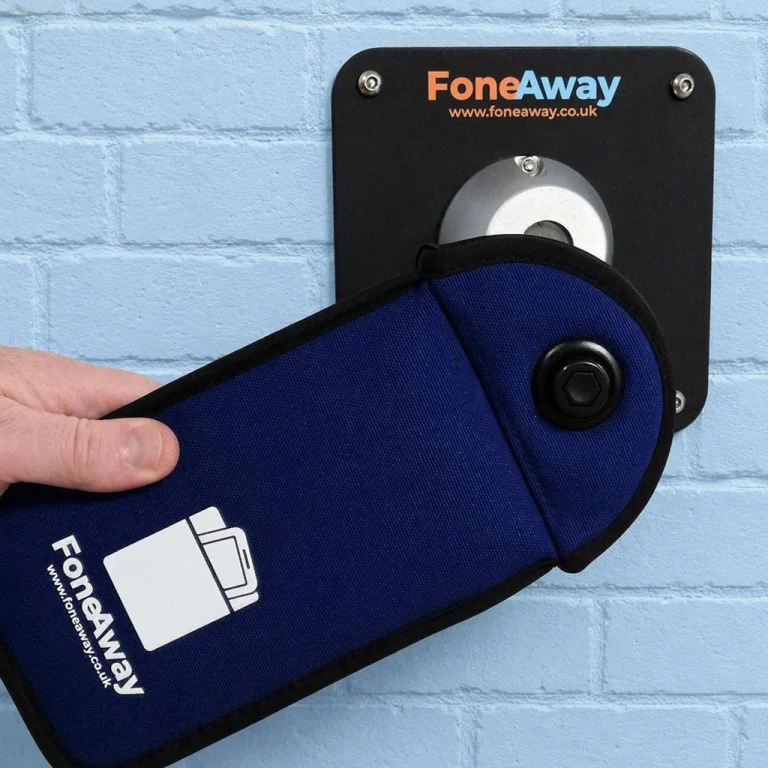
For schools wanting pupils to keep their phones on them while preventing access during the school day, lockable pouches offer a practical middle ground. Rather than potentially having to collect hundreds or even a couple of thousand phones every morning and storing them somewhere secure.
- Pupils have their own individual pouch
- The phone is put inside and the pouch is locked
- The pupil keeps the pouch but can’t access the phone until it is unlocked.
The DfE’s own case studies include a secondary school with more than 1300 pupils using this approach. The school reported choosing pouches partly because they created an additional barrier between pupils and the temptation to use their phones, an important point for schools. The pouch isn’t the policy. The policy is the school’s expectation that phones can’t be accessed during the school day. The pouch is just one possible mechanism for making it happen.
How FoneAway Can Support a Phone-Free School
For schools considering a pouch-based approach, FoneAway lockable phone pouches are a practical way to let pupils keep their phones on them while preventing access.
- FoneAway pouches have a tough, reliable magnetic locking mechanism
- They’re designed to fit all conventional smartphones
- They include space for other gadgets like smartwatches
- They can be personalised to your school
- They feature a transparent card window pocket for ID cards
- The internal RFID blocking screen prevents enclosed devices from receiving signals
- They feature rugged protective padding
- They’re a high quality, long-lasting choice.
Because the pupil keeps the phone and the school controls when they can access it, staff avoid the time-consuming practical problems associated with collecting, labelling, storing and returning large numbers of valuable personal devices. It also makes the school’s expectations easier to communicate: bring your phone if you need it for your journey. Lock it away when you arrive. Use it again when the school day ends.
FAQs
Here are some quick answers to some of the most frequently asked questions about phone-free schools.